Model Context Protocol (MCP)
Experimental Feature
MCP features are currently experimental and under active development. Features and APIs may change.
marimo supports the Model Context Protocol (MCP) in two ways: as an MCP server that exposes marimo's AI tools to external applications, and as an MCP client that connects supported servers to marimo's chat panel.
Prerequisites
Both MCP server and client features require the MCP dependencies. Run marimo with MCP support using one of the following methods:
Flags
The --mcp flag exposes an endpoint that provides access to your notebook data via the MCP server endpoint. Remove --mcp if you only want MCP Client features. The --no-token flag removes authentication, which should only be used for local development. Remove --no-token in production environments.
MCP Server
marimo can expose its AI tools through an MCP server endpoint, allowing external AI applications to interact with your notebooks. If your goal is to have a coding agent manipulate a running notebook, see marimo pair instead.
Available tools
When connected to marimo's MCP server, external applications can access the following categories of tools.
Inspection
| Tool | Description |
|---|---|
| get_active_notebooks | List all currently active marimo notebooks. Returns summary statistics and notebook details including names, paths, and session IDs. Start here to discover which notebooks are available. |
| get_lightweight_cell_map | Get an overview of notebook structure showing a preview of each cell. Takes a session_id and optional preview_lines parameter. Returns cell IDs, preview text, line counts, cell types (code, markdown, SQL), runtime state (idle, running, queued, etc.), and has_output/has_console_output flags. |
| get_cell_runtime_data | Get detailed runtime information for one or more cells. Takes session_id and cell_ids (list) parameters. Returns full cell code, error details, runtime metadata (execution time, runtime state), and variables defined by each cell. |
| get_cell_outputs | Get execution output from one or more cells. Takes session_id and cell_ids (list) parameters. Returns visual output (HTML, charts, tables, etc.) with mimetype, stdout messages, and stderr messages for each cell. |
| get_cell_dependency_graph | Get the cell dependency graph showing variable ownership and cell relationships. Takes session_id and optional cell_id and depth parameters. Returns cell dependency info (defined variables with kind and runtime type, referenced variables, parent/child cells), a variable ownership map, multiply-defined variables, and cycle information. Use cell_id to center on a specific cell and depth to limit traversal hops. |
Data
| Tool | Description |
|---|---|
| get_tables_and_variables | Get information about variables and data tables in a session. Takes session_id and variable_names parameters (empty list returns all). Returns table metadata (columns, primary keys, indexes, row counts) and variable values with data types. |
| get_database_tables | Get database schema information with optional query filtering. Takes session_id and optional query parameter (supports regex). Returns tables with connection name, database, schema, and table details. |
Debugging
| Tool | Description |
|---|---|
| get_notebook_errors | Get all errors in the notebook organized by cell. Takes session_id parameter. Returns error summary (total errors, affected cells) and per-cell error details (type, message, traceback). |
| lint_notebook | Get all marimo lint errors in the notebook. Takes a session_id parameter. Returns lint errors as defined in the lint rules documentation. |
Reference
| Tool | Description |
|---|---|
| get_marimo_rules | Returns marimo's rules and best practices for AI assistants. |
Available prompts
When connected to marimo's MCP server, external applications can access the following prompts:
| Prompt | Description |
|---|---|
| active_notebooks | Get current active notebooks and their session IDs and file paths. Returns session IDs and file paths for all active marimo notebook sessions, along with guidance on using these IDs with marimo MCP tools. |
| errors_summary | Get error summaries for all active notebooks. Returns a summary of all errors across active notebooks organized by notebook and cell, including error types, messages, and affected cell IDs. |
Connecting external applications
marimo's MCP server works with any MCP-compatible application. Below are setup instructions for some commonly used applications:
Connection details
Replace PORT with your marimo server port in the examples below. If authentication is enabled, append ?access_token=YOUR_TOKEN to the URL and replace YOUR_TOKEN with your marimo access token.
Claude Code
Use Claude Code's CLI to connect to marimo:
Cursor
Configure Cursor to connect to marimo's MCP server:
VS Code
Create a .vscode/mcp.json file in your workspace and configure it to connect to marimo's MCP server:
DNS rebinding protection
marimo's MCP server enables DNS rebinding protection by default, which validates the Host header on incoming requests. This is common when using proxies, gateways (e.g., ECS), CDNs (Cloudflare), or custom domains, where the forwarded Host header won't match the expected local host, causing 421 Misdirected Request or Invalid Host Header errors. Pass --mcp-allow-remote to disable this check:
MCP Client
marimo can connect to external MCP servers to add additional tools and context to the chat panel.
Supported servers
marimo currently supports the following MCP servers:
| Server | Description |
|---|---|
marimo |
Provides marimo's official documentation, API reference, and code examples |
context7 |
Fetches up-to-date, version-specific documentation and code examples from official sources |
Support for custom MCP server configuration is not yet available.
Configuration
Enable MCP client servers through the marimo settings UI:
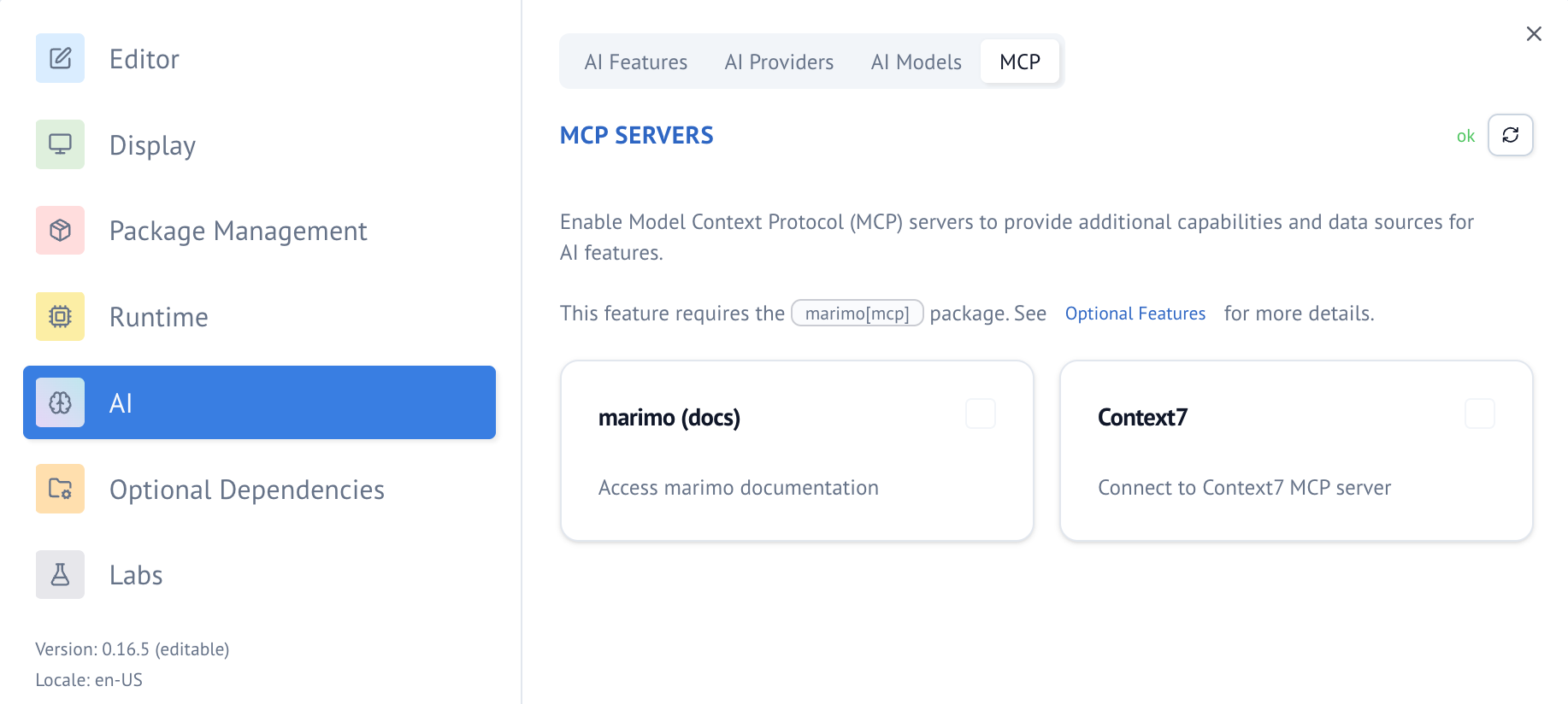
Alternatively, configure MCP servers in your marimo configuration file:
Configured servers provide tools to the chat panel with Read only or Suggest edits access. These access levels restrict marimo's built-in notebook tools. They do not restrict what connected MCP tools can do.